The Pollen Robotics Dev Stack: Reachy Mini & Microduck SDKs, Explained
One French robotics team, two cute robots, one open pipeline — what you actually get to program, from Python SDK to MuJoCo sim to the Hugging Face Hub.
IN VERIFICATION
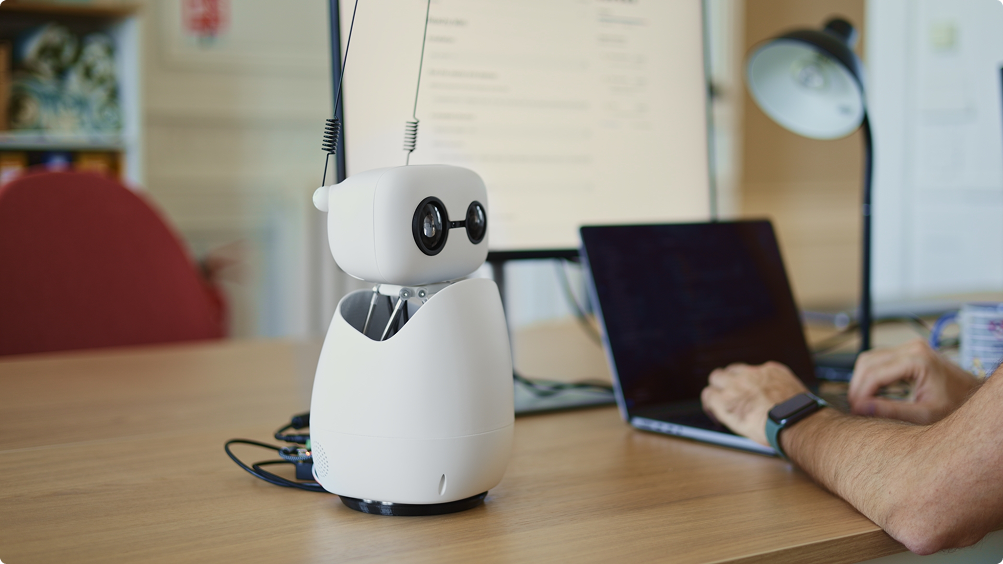
Pollen Robotics ships the most complete open dev stack in the home-robot class, and it works the same way across both of its registry entries: everything is Apache-2.0, everything lives on GitHub, and the community layer runs through the Hugging Face Hub.
The layers, bottom to top
Hardware access. Both robots expose their motors and sensors through a published Python SDK. Reachy Mini’s is the mature one — a year of batch shipments means its API surface has been exercised by thousands of owners, and the install is a pip away:
from reachy_mini import ReachyMini

mini = ReachyMini()
mini.head.look_at(x=0.5, y=0, z=0.2)   # 6-DoF neck does the acting
mini.antennas.set_position(left=45, right=-30)
Simulation. Microduck is where the stack gets serious: the entire reinforcement-learning training pipeline is public, with MuJoCo as the physics backend. The seven shipped behaviors — walking through roller-skating — are published policies you can retrain. This is the sim-to-real loop that industrial labs use, at a $399 price point, per the official docs.
Distribution. Behaviors and apps are shared as Hub artifacts. For Reachy Mini this already works like an app store with a package manager’s manners; Microduck inherits the mechanism at launch.
Registry pick: for programming a robot this weekend, Reachy Mini Lite at $299 is the shortest path in the registry — the recommendation boxes below carry the full case.
What the docs tell you (and what they don’t)
The documentation covers install, API reference, and sim workflows credibly. What no doc yet covers, because units haven’t shipped: Microduck’s real-world battery behavior under training loads, and how policy transfer survives carpet. Owner evidence lands here when it exists — this is a doc-sourced report, and it says so.
The registry’s read
If you want to program a robot this weekend, Reachy Mini is the shorter path: shipping now, mature SDK, working app ecosystem. If you want to train a robot — actual RL, actual sim-to-real — Microduck is the only thing at this price that hands you the whole pipeline. The two share tooling, which is not an accident; see the full comparison.
Your first mod (no experience required)
The gentlest entry into the whole Pollen stack asks for zero code: teach Reachy Mini a greeting. In the companion app, browse the community behaviors on the Hugging Face Hub, install one — “head-tracking hello” class — and run it. That’s the confidence step: you just deployed software to a robot.
The actual mod is one number. Open the behavior’s settings (or, feeling brave, the Python example from the docs) and change the antenna angle in the greeting — from polite 30° to enthusiastic 60°:
mini.antennas.set_position(left=60, right=-60) # was 30; enthusiasm is a parameterWhat you need: the robot, its app, twenty minutes after bedtime. You did it when: the robot greets whoever walks in your way, not the default way. If it goes wrong: re-install the original behavior from the Hub — nothing you do here can hurt the robot, which is rather the point of the whole platform.
Sources: Pollen’s SDK and sim repos on GitHub (Apache-2.0), the Microduck product documentation, and the Hugging Face Reachy Mini announcement — linked from the specimen source records.
Registry recommendations from this report
Mature Python SDK, a year of exercised installs, and a working app ecosystem — the robot you actually program this weekend.
Read the review →
The only sub-$400 machine that hands you the full sim-to-real RL loop. Preorder with eyes open; the pipeline is real today, the robot ships pre-Christmas.
Read the review →The robots in this report
-
№ 0002 Open Platforms
Reachy Mini
Cervicula expressiva
IN STOCK
The dev community's desk companion of record.
-
№ 0001 Open Platforms
Microduck
Anas machinalis
PREORDER
The roller-skating open-source duckling.